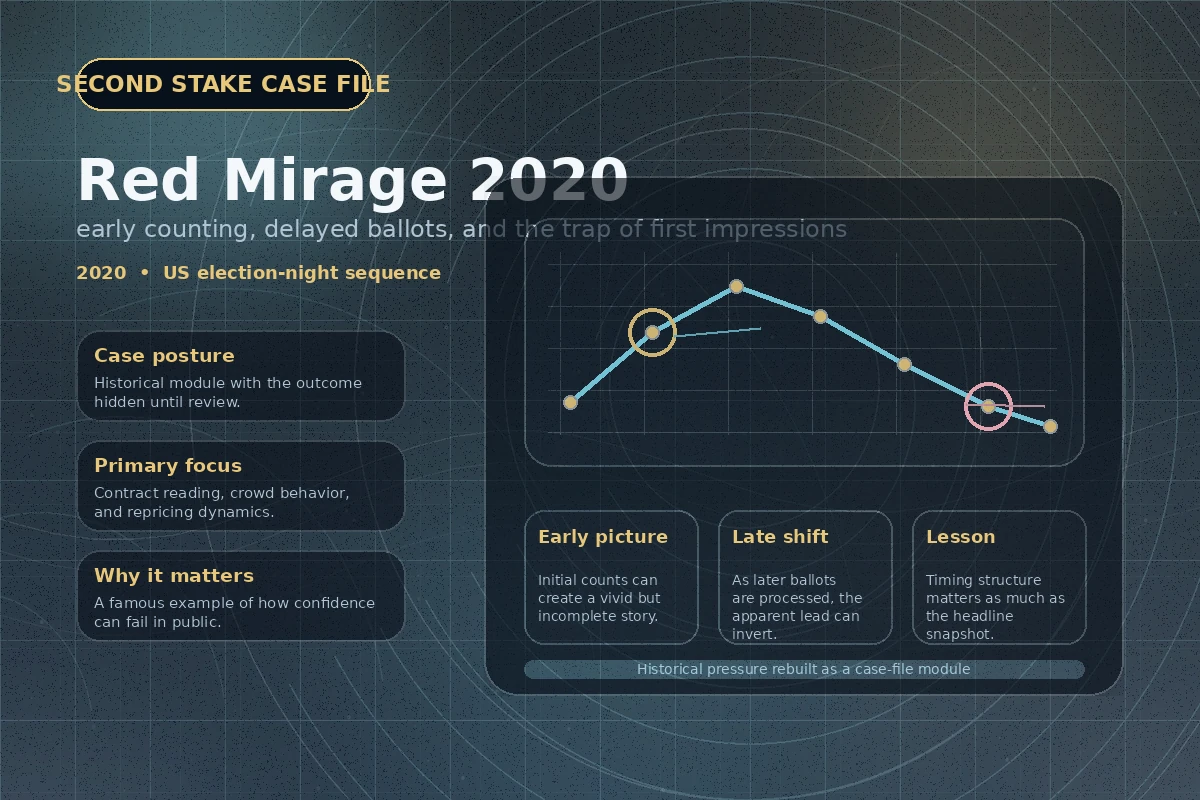
Partial information can look like final information when it arrives with enough speed and confidence. Commit a fake-money decision before you reveal the historical outcome.
Partial InformationIntermediate$1,000Gameplay 051
Open, layered, contract-first market reading.
Your seat at the table
You are watching election-night markets while results arrive in a sequence shaped by vote-counting rules, mail ballots, and state-level reporting differences.
Market setup: Early counts produce visible price movement. Traders react to the screen before fully accounting for counting order and delayed ballots.
Market context: The central question is not who will win. The central question is whether the current information is representative or merely early.
Hidden enemy
Early Count Trap
Early-count bias made partial data feel complete.
Bankroll: $1,000Skill: Timing discipline under noisy partial information.Reveal locked until commit
What you know
Counting order can distort early impressions.
Mail ballots and state procedures affect timing.
Markets can overreact to visible but incomplete information.
A lead on the screen is not the same as a final outcome.
What you do not know yet
How much of each vote type remains uncounted.
Which states will report late-changing batches.
How much the market already understands about the counting sequence.
Decision prompt
With $1,000 fake money, do you chase the apparent early leader, wait for counting structure to clarify, hedge timing risk, or pass?
This is the commit point. Pick your posture, choose a fake-money stake, write the reason in your head, then press Commit. You cannot score yourself honestly if you read the reveal first.
Choose your posture
These labels are intentionally broad. The point is to name your decision style before history tells you which label feels smart.
Choose fake-money stake
How much of $1,000 are you willing to risk?
This is not real money. The stake exists so your decision has weight. Oversizing a comfortable story is part of the lesson.
Commit decision
Decision ticket
Choice:Not selected
Action:Choose a posture above.
Stake:Not selected
Select a posture and stake first. Then commit before opening the reveal.
Decision timeline
Move beat by beat. Ask what the market is inviting you to do and what the contract-aware version of you should do instead.
01
Pre-election timing map
Map timing or ignore it.
Available information: Counting rules and mail-ballot timing are known concerns.
Market pressure: Prepare before the first numbers hit.
02
Early visual lead
Chase, wait, or hedge.
Available information: Initial counts create a strong screen impression.
Market pressure: The market rewards fast reaction.
03
Count-order question
Hold back or trust the screen.
Available information: The visible lead may be shaped by vote type and reporting order.
Market pressure: Patience feels like cowardice.
04
Late batch shift
Exit, reverse, or follow the count map.
Available information: Additional ballots change the apparent state of the race.
Market pressure: The early read weakens.
05
Reveal
Review whether you traded information or presentation.
Available information: The early picture was incomplete.
Market pressure: The screen was not the finish line.
Reveal locked
Commit first. Then open history.
The reveal is hidden so the module stays honest. After you commit, the result, trap diagnosis, and review panels unlock below.
Historical reveal
Later-counted ballots change the apparent picture. The early visual lead was not the final market truth.
Outcome: The market punished traders who confused reporting sequence with outcome certainty.
Your committed ticket:Review your selected posture and stake above.
Trap diagnosis
Early Count Trap
This module trains the user to ask, “What part of the evidence pipeline am I seeing right now?” The visible screen may be true and still incomplete.
Lesson carried forward: Before reacting to live data, map the order in which information arrives. Some markets are not about facts; they are about sequencing.
After-action review
Score the process, not the outcome.
Did you know what kind of votes were being counted first?
Did the live screen make the trade feel more certain than it was?
Could waiting have been a decision instead of indecision?
Best process outcome: You identify the count-order problem and avoid treating early returns as final evidence.
Bad process outcome: You buy the visible leader because the screen feels decisive.
Finish the loop
Carry the lesson into the Field Room.
Open the autopsy after you finish. Then run the related prompt and read the field note.